Bay County Prevention Network
989-895-3510
  • Home
    • Contact
    • 2012 Accomplishments
    • BCPN Newsletters
    • Blog
  • Subcommittees
    • Underage Drinking>
      • Consequences
      • Cost of Underage Drinking
    • Prescription Drugs
  • Statistics
  • Important Links & Phone Numbers
    • On-line Recovery Resources
    • Quote of the Day
  • Calendar of Events
    • Town Hall Meeting
    • Comedy Show
    • Drug Take Back Program
    • Photos

Bay County Youth

Bay County Underage Drinking Statistics

   The tables below contain the results of the Michigan Profile for Healthy Youth survey of Bay County 7th, 9th and 11 grade students completed in the 20011/2012 school year. The MiPHY is an online student health survey offered by the Michigan Departments of  Education and Community Health to support local and regional needs assessment. The MiPHY provides student results on health risk behaviors including substance use, violence, physical activity, nutrition, sexual behavior, and emotional health in grades 7, 9, and 11. The survey also measures risk and protective factors most predictive of alcohol, tobacco, and other drug use and violence.

Recent Alcohol Use

5% of Bay County 7th grade students reported drinking alcohol in the past month, with 3.4% of those 7th graders reporting that they had drank 5 or more drinks in a row in the last thirty days. These numbers have decreased from 2010. However, the numbers increase for Bay County 9th graders with 22% reporting past 30 day use - and 10.2% report binge drinking in the past 30 days.  For Bay County 11th grade students, 30.2% reported drinking in the past 30 days, with 20.8% reported having binged drank in the past 30 days. The numbers for 9th graders increased  from the 2010 data for past month use.

Alcohol and Vehicle Safety

The percentage of 7th grade Bay County Youth who rode in a car or other vehicle driven by someone who had been drinking alcohol one or more times during the past 30 days is 26.1%, 9th graders was 20% and 11th graders was 18.8%. These number are down significantly from the 2010 data for all three grades. 

The percentage of 9th grade students who have driven after drinking alcohol is 4.4% and 11th graders is 8.3%. As 7th graders do not yet have their licenses, and very few 9th graders are driving motorized vehicles the highest percentage belong to Bay County 11th grade students, with 8.3% having identified driving after drinking, in the last 30 days. This percentage significantly decreased from the 2010 data.

How Easy is Alcohol to Get
According to the data, 33.5% of 7th graders, 65.4% of 9th graders and 73.1% of 11th graders surveyed, indicated that alcohol was sort of easy or very easy to get in Bay County.

Where do Youth Get Alcohol?

Data reported in the MiPhy survey indicates that 0% of 7th graders, 0% of 9th graders, and 1.9% of 11th graders bought the alcohol they drank in a store.  While data is not available on all sources, history shows us that most under-age youth get alcohol from:

· Their parents—either given to them or stolen from their parents refrigerators and liquor cabinets.
· Older friends or siblings                                 
· Theft from local stores

The underage drinking problem is one which, more than most others, seems to lead to a lot of finger-pointing, denial, and blaming of others. The fact is, no one person is responsible for the underage drinking problem, and no one person is capable of solving it.  While the problem may be best measured while the students are in the schools, it is a problem which exists in, and must be dealt with, by the larger community as well as the school system. Schools can do some things, but there are some things only parents can do, others only law enforcement can do, and still others only the community’s leadership can tackle. One of the most important things to have occur is for all adults in the community to acknowledge that they “own” part of the problem, and thus have a vital role to play in its solution.


  6 Good Reasons Why Teens and Alcohol

Are a BAD Combination

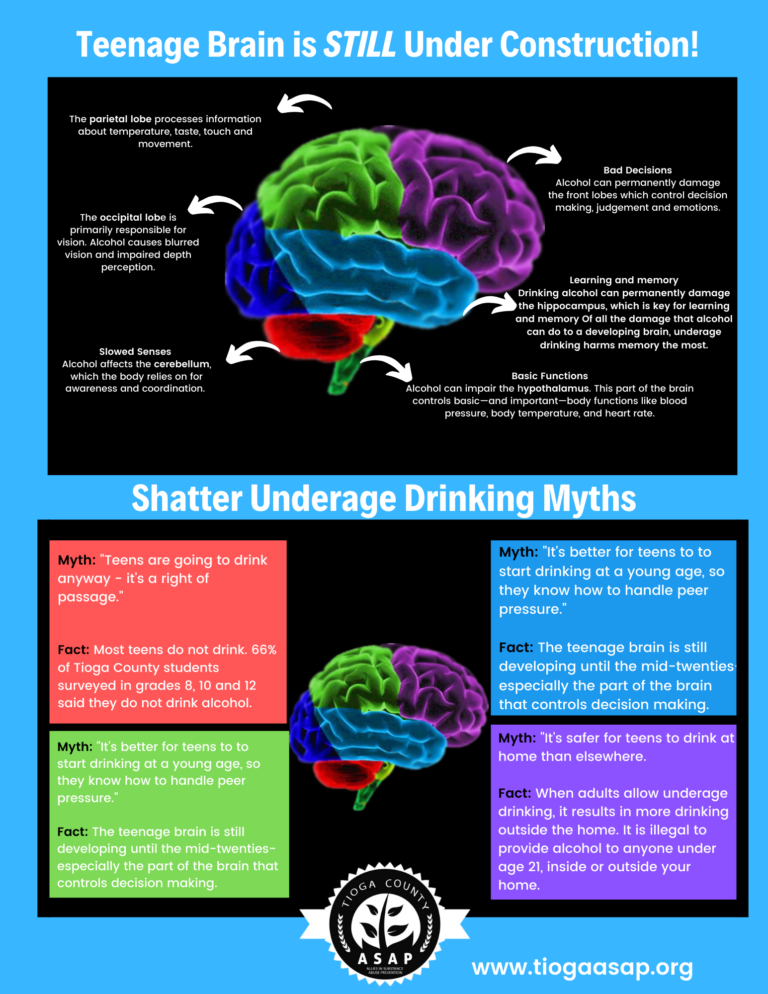
  1. Your teen’s brain is still developing and is a “work in progress”. 
      Research by the NIDA (the National Institute of Drug Abuse) found that the brain’s frontal lobes, a critical area for the development of judgment and acquiring information, is not fully developed until someone is in his/her 20’s. Considerable research tells us that regular use of alcohol by adolescents can have life-long negative effects on their brain chemistry and the structural organization of the brain. 

2.  Teens do not always make good decisions.
Alcohol use decreases impulse control and increases risky decisions that can lead to injury, dangerous sexual behavior, sexual assault or other kinds of violence, alcohol poisoning, and even death. 

3. Teen use of alcohol is illegal.
Teens who drink are breaking the law. It is illegal for adults, even a teen’s parent, to allow a teen to drink. It is important for you, as a parent, to send a CLEAR message to your son or daughter that  underage drinking is illegal; unacceptable to you; and will result in family consequences. 

4. Research tells us that postponing alcohol use beyond the teen years SIGNIFICANTLY      decreases your teen’s likelihood of addiction as an adult.
In a recent study, drinking to get drunk was the main reason for drinking cited by nearly half the youth. Another survey found that most teen drinkers binge. 

5. Teen use of alcohol and other drugs, like marijuana, is a primary issue in
youth traffic accidents and fatalities.
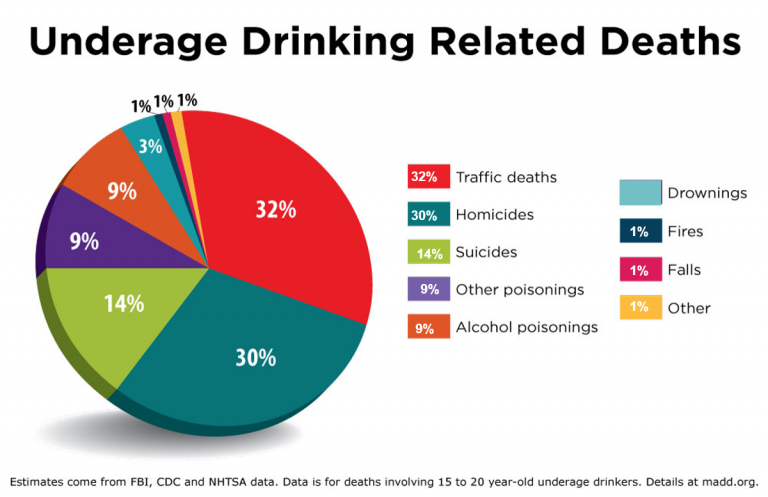
Did you know that the leading cause of death for youth, ages 15 to 20, is a car crash and that alcohol is a factor in 1/3 of the crashes involving teens? 

6. If your teen drinks alcohol, s/he can face SERIOUS legal and other consequences.
These consequences can include driver’s license suspension or restriction, substance abuse screening and treatment at YOUR expense, fines up to $500, court costs, and community service. In addition, insurance coverage rises significantly or can be cancelled for conviction of alcohol-related offences. Teens found guilty of an alcohol offence may not be admitted to the college of their choice and can be ineligible for college scholarships. 

 
THERE ARE MANY GOOD REASONS THAT THE LEGAL DRINKING AGE IS 21 YEARS.


Share this information with your teen today!

TEENS AND ALCOHOL ARE A BAD COMBINATION! 

 
                                                 A message from the Bay County Prevention Network
Picture

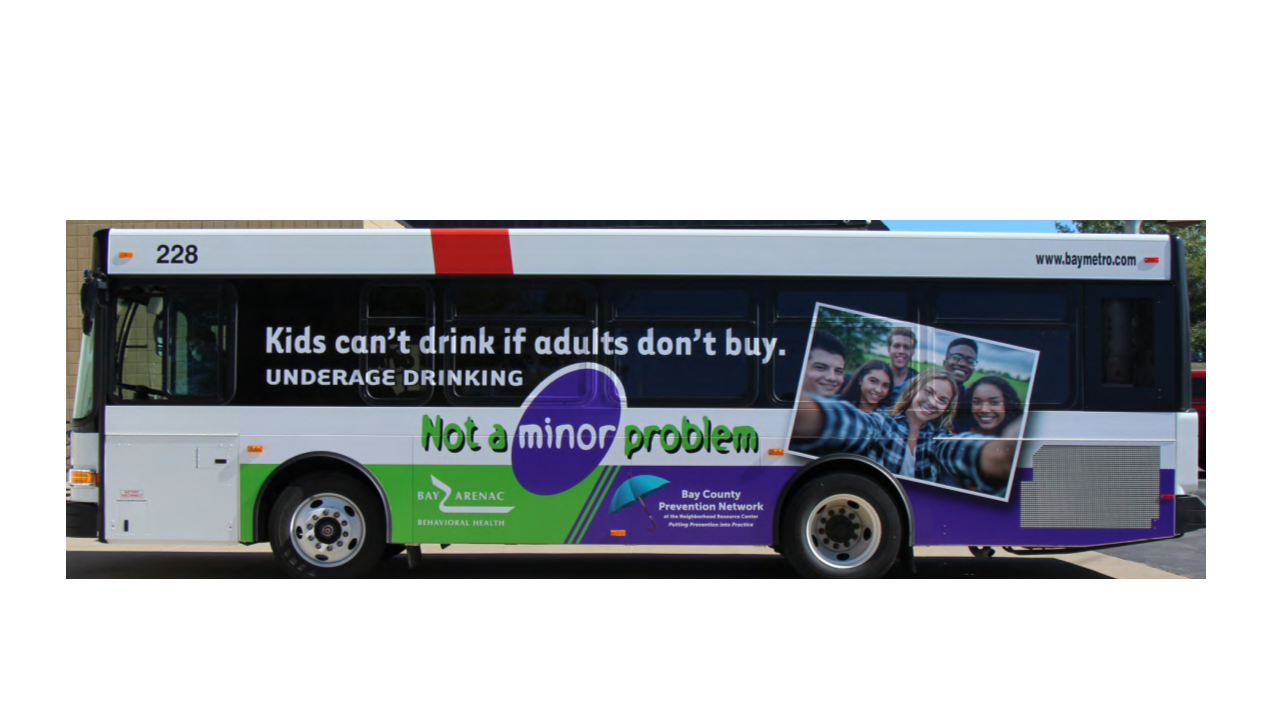
Underage Drinking Not a Minor Problem Moving Billboard Ad

Picture